Textile Care & Bedding Basics
Organic Sheets Explained: Fiber Claims, Weaves, and Care
An organic label can tell you something important about how a fiber was grown and handled. It cannot tell you whether your sheets will feel cool and crisp, smooth and drapey, or gently rumpled. For that, look beyond the label: fiber, weave, fabric weight, finishing, and care all shape the experience.
Published October 16, 2026
Shopping for sheets can feel like learning a new language. “Organic,” “percale,” “sateen,” and “linen” often appear together, but they describe different things. Organic usually refers to standards for growing and processing a fiber. Percale and sateen describe ways yarns are woven. Linen names a fabric made from flax fibers. None of those terms, by itself, gives the whole story.
That distinction matters. Two sheets may both be organic cotton yet feel remarkably different because one is a crisp percale and the other a smoother sateen. Organic linen may be airy and textured, while cotton percale tends to feel flatter and more structured. And a responsible fiber claim is not a promise that a sheet will never wrinkle, shrink, fade, or wear.
This guide breaks down what organic labels can—and cannot—tell you, how linen and cotton weaves compare, and which everyday care habits can help preserve bedding. The goal is practical: read the label with confidence, choose for the feel you actually like, and give the fabric a better chance of lasting.
What does “organic” mean on sheets?
Organic is a claim about fiber production, not a particular texture. In the case of cotton, it generally refers to cotton grown under a recognized organic agricultural standard, with rules governing matters such as prohibited substances and farming practices. The precise requirements depend on the certification scheme and the country or market involved.
Labels may also refer to the processing of the textile after the crop is harvested. Some standards cover only the organic content of a product; others assess parts of the manufacturing chain, including processing and chemical inputs. That difference is worth noticing. A label that verifies organic fiber content does not automatically mean every dye, finish, sewing step, or workplace practice has been evaluated under the same standard.
Certifications such as the Global Organic Textile Standard (GOTS) and the Organic Content Standard (OCS) have different scopes and verification requirements. They are not interchangeable shorthand for “the same thing.” If a claim matters to you, check the certification name, the product’s scope, and whether the finished item—not simply the raw fiber—is covered. A brand’s explanation can be helpful, but a specific standard or certification provides more useful detail than a vague phrase such as “made with organic materials.”
Organic is also not a universal synonym for sustainable, chemical-free, or harmless. Textile production involves multiple stages, and environmental impacts depend on many factors, including farming, water use, dyeing, energy, transportation, durability, and what happens at the end of a product’s life. A credible certification can offer a meaningful, defined assurance; it should not be asked to prove more than its rules cover.
A quick label-reading checklist
When you are comparing organic sheets, pause over the full product description rather than relying on a large front-of-package claim. These questions can help make the language more concrete:
- Which fiber is organic? Is it cotton, flax, or a blend—and what percentage of the fabric does it represent?
- Is a certification named? Look for the standard and, when available, certification or license details you can verify.
- What does the certification cover? The fiber, the processing stages, or the finished textile may be treated differently.
- What else is in the fabric? A sheet may combine organic and conventional fibers or include elastic, embroidery, or other components.
- Are the weave and care instructions clear? These details are more useful for predicting everyday feel and maintenance than the word “organic” alone.
For organic linen sheets, look specifically for information about the flax fiber and any relevant certification. The term “linen” tells you the fiber comes from flax; it does not, on its own, establish that the flax was organically grown. Similarly, a natural fiber is not necessarily an organic fiber. Clear wording helps you distinguish material identity from growing method and certification.
Fiber tells you what the material is; weave shapes how it feels
Fiber and weave work together, but they answer different questions. Fiber identifies the material—cotton, flax linen, or a blend, for example. Weave describes how yarns cross one another to form cloth. Finishing, yarn quality, fabric weight, and construction add further variation.
That is why “cotton sheets” is not a complete description. Cotton percale and cotton sateen use the same broad fiber family, yet their surfaces can feel quite different. Long-staple cotton is often used to make smooth, durable yarns, but the finished feel still depends on how those yarns are woven and treated. Thread count may be one specification, but it is not a reliable shortcut for softness or quality on its own.
Likewise, linen’s characteristic texture is not a certification feature. It comes from flax fiber and the way the yarn and fabric are made. Linen can be woven at different weights and finishes, so one set may feel light and relaxed while another feels more substantial. If possible, consider both the stated construction and a fabric sample; a few minutes of touch can tell you things a label cannot.
Plain-weave linen: airy, textured, and naturally relaxed
Plain weave is a straightforward structure: each yarn passes over and under the yarns crossing it in an alternating pattern. In linen bedding, that construction can bring out the fabric’s natural texture and create a surface that feels crisp at first, then softens with use and laundering. The exact result depends on the flax yarn, the fabric’s weight, and its finish.
Linen is often appreciated for its breathable feel and relaxed appearance. It tends to crease more readily than some cotton fabrics, and those creases are part of its familiar character—not automatically a sign of poor quality. If you prefer a perfectly smooth bed, you may find linen needs more attention than you want to give it. If you enjoy a softly rumpled finish, its texture may feel like a welcome feature.
Care needs are practical rather than mysterious. Linen can be washed at home when the care label allows, but rough handling, an overloaded machine, excessive heat, or prolonged over-drying can put needless strain on the cloth. Linen fibers are durable, yet durability does not mean invulnerability. Use a suitable cycle, give the fabric room to move, and remove it before it becomes bone-dry if you want to make finishing easier.
When considering organic linen sheets, keep the two questions separate: Is the flax fiber certified organic under a stated standard? And do you like the weight, weave, and texture of this particular linen? A positive answer to the first does not guarantee the second—and both matter for a sheet you will use night after night.
Cotton percale: crisp and matte
Percale is typically a plain weave, commonly associated with a cool, crisp hand and a matte appearance. The tidy, balanced structure gives the surface a clean feel that many people prefer in warmer rooms or when they like bedding that feels light rather than glossy. The word percale does not tell you whether the cotton is organic; that claim needs to be established separately.
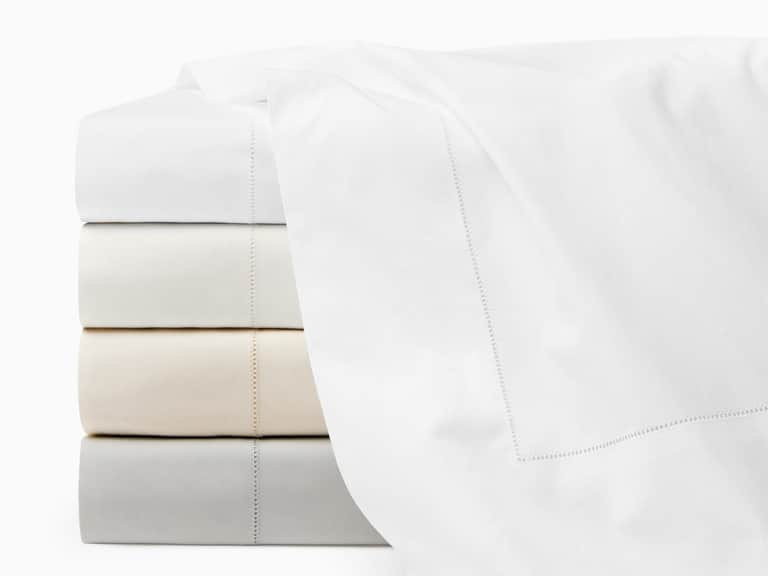
For a useful construction example, the Luxor Flat Sheet is described as 100% Egyptian cotton percale, with a light, airy feel, matte finish, and hemstitch detail. Its product information does not identify the cotton as organic, so it should be understood here as an example of percale—not as an organic-sheet recommendation. That distinction is exactly why fiber, weave, and certification deserve separate attention.
Percale can wrinkle, particularly when it is left in a warm dryer after the cycle ends. Removing it while slightly damp, smoothing it by hand, and folding or placing it on the bed promptly can reduce the most pronounced creases. If crispness is your priority, a light iron or steam treatment may help, provided the care instructions allow it.
Cotton sateen: smooth with a soft sheen
Sateen uses a weave structure that places more yarn floats on the fabric’s surface than a basic plain weave. That construction can make the cloth feel smoother and look subtly lustrous. Sateen is still cotton when cotton is the fiber, but its hand and appearance differ from percale. It may feel more drapey and silky to someone who finds percale too crisp.
Sateen’s surface may be more susceptible to pulls or abrasion than a simple, tightly balanced weave, depending on the yarn and construction. That does not mean it is fragile; it means care should match the cloth. Turn embellished pieces inside out when the care label permits, avoid washing them with items that have hooks or rough fasteners, and use a gentle cycle when recommended.
Organic cotton sateen is possible, just as organic cotton percale is. The organic claim concerns the fiber’s verified origin and any applicable processing standard, while “sateen” tells you about the weave. One label cannot substitute for the other.
Weave, weight, and feel: how to compare sheets fairly
Marketing language can make every sheet sound cloud-soft, breathable, and long-lasting. To compare options more carefully, look for concrete descriptions alongside those impressions. A well-written listing will identify fiber content, weave, approximate weight where available, finishing, origin information, and care instructions.
Fabric weight can help explain why two items with the same fiber and weave feel different. A lighter cloth may feel more fluid and airy; a heavier one may feel more substantial. Those are tendencies, not guarantees, because yarn size, density, and finishing also play a role. A number such as thread count should be considered in context rather than treated as a scorecard: measurement methods and construction differ, and a higher figure alone does not prove better performance.
It is also useful to consider details beyond the main field of fabric. Hemstitching, embroidery, piping, and decorative cuffs can affect laundering and ironing. A plain sheet and an embroidered sheet may be made from similar cotton but still require different care. If the product page lists a specific temperature, cycle, or drying method, use that as the starting point rather than assuming every cotton sheet can be treated the same way.
A gentle washing routine that protects bedding
There is no single care routine for every organic sheet or linen set. Fiber blends, dyes, finishes, and decorative details all matter. The sewn-in label or manufacturer’s care instructions should take priority over general advice. Still, a few habits are widely useful for everyday bedding:
- Sort thoughtfully. Wash light and dark colors separately, and keep sheets away from rough garments, zippers, and hooks that can snag the surface.
- Avoid crowding the washer. Bedding needs room to move and rinse. An overloaded machine can twist fabric and leave detergent behind.
- Choose a suitable cycle. Use the temperature and cycle named on the care label. A gentle cycle can be appropriate for delicate finishes or embroidery, but it is not a universal requirement.
- Measure detergent carefully. More soap is not better. Excess detergent can be difficult to rinse away and may leave a dull or stiff residue.
- Skip unnecessary additives. Avoid chlorine bleach unless the care instructions expressly allow it. Fabric softener can affect absorbency and surface feel, so follow the maker’s guidance.
- Dry with restraint. Use the stated setting and avoid prolonged heat. Remove sheets promptly, while they are slightly damp if appropriate, to limit hard-set wrinkles and unnecessary wear.
For linen, gentle washing and avoiding over-drying can help preserve the fabric’s texture. For cotton percale, prompt removal from the dryer can make wrinkles easier to manage. Sateen and embroidered bedding may benefit from added attention to cycle choice and contact with abrasive items. The label is the final authority because a finish or trim can change what is safe for the whole piece.
Shrinkage, wrinkles, and other common concerns
Will organic sheets shrink? Organic certification does not determine shrinkage. Fiber, fabric preparation, construction, and exposure to heat all play a part. Cotton and linen can change dimensions if washed or dried outside the recommended conditions, but the degree varies. Follow the care label and avoid assuming that “organic” means pre-shrunk.
Do linen sheets always need ironing? No. Linen’s creased look is a natural consequence of the fiber and its behavior. If you want a neater finish, smooth the fabric while damp and iron or steam only as the care directions permit. Many people choose linen precisely because it looks relaxed without requiring a perfectly pressed surface.
Does a higher thread count mean better sheets? Not necessarily. Thread count is one detail, not a complete measure of comfort or durability. Fiber quality, weave, finishing, and construction all contribute. A breathable percale at a moderate count may suit one sleeper better than a denser sateen, while another person may prefer the sateen’s smoothness.
Does “natural” mean “organic”? No. Natural describes a material’s broad origin, while organic refers to production under defined standards. Linen is made from flax, but flax linen is not automatically certified organic. Look for specific wording and documentation rather than inferring a certification from the fiber name.
How to make sheets last longer
Good care begins before laundry day. Rotate between sets if you have more than one, so each gets time away from repeated washing and wear. Keep bedding dry before storing it, and choose a clean, well-ventilated cupboard rather than a damp space. Avoid storing sheets in direct sunlight for long periods, which can contribute to fading.
Inspect hems and seams occasionally. A small loose thread can often be secured before it unravels further; avoid pulling it. If a sheet develops a stain, treat it promptly and gently, checking that the stain treatment is suitable for the fiber and color. Heat can set some stains, so do not put an item in a hot dryer until you have checked the result.
Longevity is also an environmental consideration. A certified fiber claim may be important, but a sheet that is used and cared for over many years can be more useful than one replaced quickly. Choose a weave and feel you will genuinely enjoy, follow the garment’s instructions, and repair minor problems where practical. Care cannot erase every impact of production, but it can help avoid premature replacement.
The simple takeaway
Organic sheets are best understood through three separate questions. First: what fiber is present, and is its organic status verified by a named standard? Second: what weave and weight create the feel you want? Third: can you care for the finished fabric in a way that fits your routine?
For a crisp, matte surface, cotton percale may be a natural place to start. For a smoother, softly lustrous hand, consider cotton sateen. For a breathable, textured, easygoing bed, plain-weave linen may be appealing—especially if a relaxed crease is part of the charm. Organic linen sheets can combine an organic-fiber claim with that distinctive linen character, but neither trait guarantees a particular weight, softness, or level of wrinkling.
Read the full label, separate certification from construction, and let care instructions guide the wash. Once those pieces are clear, choosing sheets becomes less about decoding buzzwords and more about finding the fabric that feels right in your home.
Quick reference
- Organic: A claim about fiber production and, depending on the standard, aspects of processing—not a description of texture.
- Plain-weave linen: Often textured, breathable, and naturally prone to a relaxed crease.
- Cotton percale: Commonly crisp, cool-feeling, and matte.
- Cotton sateen: Often smoother, more drapey, and subtly lustrous.
- Care: Follow the product label, wash gently when instructed, avoid over-drying, and handle decorative details with care.